
Rabun County Parole Versus Probation
Georgia divides the work among courts, the Georgia State Board of Pardons and Paroles, and the Georgia Department of Community Supervision, known as DCS. The parole board decides whether an eligible state prisoner may serve the rest of a sentence in the community. A sentencing court orders probation. DCS supervises adult felony probationers and parolees after release. Rabun County misdemeanor or court-specific probation may use a local provider, so the name on the judgment matters.
A person can finish jail custody without finishing the sentence. Parole remains part of the prison sentence. Probation is a court-ordered period with stated terms, and it may follow confinement or be imposed instead of confinement. Neither status should be inferred from the removed county roster.
| Question | Parole | Probation |
|---|---|---|
| Who orders it? | Georgia parole board after a prison sentence | Sentencing court |
| Who handles felony supervision? | DCS | DCS |
| Best record | TPM lookup, board record, DCS office | Judgment, docket, DCS or named local office |
| How it ends | Board discharge or sentence completion | Court or agency discharge after the term |
- Parole
- Conditional community release before the prison sentence fully expires.
- Probation
- Court-ordered community supervision with stated terms.
- Discharge
- The official end of supervision.
- Absconder
- A supervised person alleged to have stopped reporting or left supervision without permission.
Verify Rabun County Release Supervision
Begin with the sentence source, not a broad name search. A Rabun County jail booking may relate to a local charge, a felony sentence bound for GDC, or an alleged supervision violation. The Inmate TPM Lookup is useful for state parole planning, but a tentative parole month is not proof that release occurred. DCS is the official supervision route once a felony parolee or probationer is in the community.
- Read the Rabun County judgment or docket to identify probation, a prison sentence, or a violation case.
- For a state prisoner, check the parole board TPM record and GDC status. Treat a TPM as tentative.
- Use the DCS field-office directory to find the office serving Rabun County.
- Contact the assigned office with enough identifying detail to distinguish people with similar names.
- Ask for official confirmation when the result will affect a court matter or release plan.
The Rabun County released-inmate search paths can help separate a county release from a GDC discharge before supervision is checked. Georgia VINE may send custody notices, but it is not the official proof that supervision began or ended.
Rabun County DCS Field Office
The Clarkesville DCS field office serves Rabun, Habersham, and Banks counties and the Mountain Judicial Circuit. It is the key local contact for adult felony parole and probation supervision tied to Rabun County. The sheriff's Jail Info page also lists a Rabun County Probation Office number. That number may relate to local probation, while felony supervision belongs with DCS. Check the sentencing document before calling.
Clarkesville Field Office
201 Monroe Street
Clarkesville, GA 30523
Phone: 706-754-9315
Monday-Friday, 8:00 AM-4:30 PM
The statewide DCS number is 678-783-4337. The Rabun Jail Info number for Rabun County Probation is 706-212-0069. An office can explain its own records and routing, but public staff may limit case details.
The official DCS office list is shown in the matching source image below.
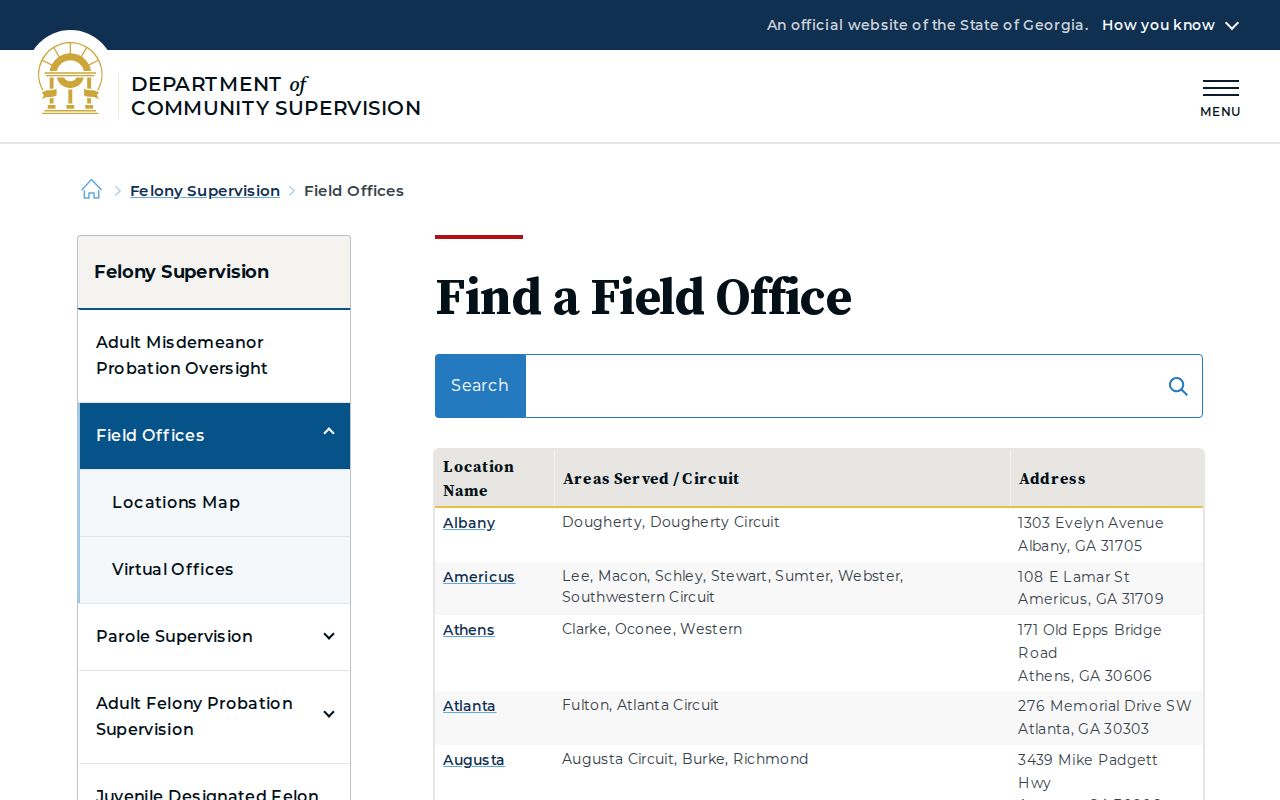
The directory confirms that Rabun County supervision is routed through Clarkesville rather than a stand-alone Rabun DCS field office.
Rabun County Parole Decision Records
Georgia parole review is largely file-based. An incarcerated person does not ordinarily appear at a public hearing for the board's case decision. Board members review records and vote. Results can include a tentative parole month, a reconsideration date, denial for the rest of the sentence, or a later change before release. The board says most parole-eligible inmates receive automatic consideration, but eligibility is not a promise of release.
Under O.C.G.A. § 42-9-45, the general felony threshold is nine months or one-third of the sentence, whichever is greater, subject to exceptions. Certain serious violent felony terms, repeat-offender rules, mandatory minimums, and life without parole can change or bar eligibility. The official parole process is the right source for those limits.
Monthly board meetings are operations meetings. Offender cases are not discussed or decided there. Notices and recordings help the public follow board business, while the TPM lookup is the practical person-specific release-planning record. A TPM can be postponed or canceled because of misconduct or unmet program terms.
Rabun County Violations And Warrants
No official Rabun-specific absconder list was found in the research. Do not turn silence into a claim. A supervision officer, court record, jail booking, or warrant authority may confirm an alleged violation. Rabun's jail guidance says that when the only jail charge is a probation or parole violation, questions about the court date should go to the probation or parole officer. That instruction reflects who holds the next-step information.
A violation allegation is not the same as a final revocation. DCS may report noncompliance, and a court or parole authority determines the response. Possible steps depend on the case and can include instructions, a warrant, custody, a hearing, modified terms, or revocation. A new jail booking may show current custody, but it does not by itself explain the final outcome.
Conditions often address reporting, travel, treatment, fees, or conduct, but only the order and supervision record establish the actual terms. Verify with the assigned office. Note: A current VINE notice can help track custody changes, but it cannot replace a supervision discharge or violation record.
Rabun County Reentry Supervision
Rabun County has no distinct county reentry office identified in the source sweep. Its local supervision landscape is instead anchored by the Clarkesville DCS office and the probation contact listed by the jail. That makes agency routing central after a GDC or court release. A state parolee should start with DCS. Someone on local misdemeanor probation should use the office named by the court.
Release from an institution may also involve property, money, clothing, or transport. Georgia corrections Rule 125-2-4 addresses possible release gratuity, clothing, transportation, and unclaimed property for qualifying institutional releases. Those state rules are not proof that every person leaving the Rabun County Detention Center receives the same aid. County-jail account and property questions should go to jail staff; GDC discharge questions belong with GDC.
Keep copies of the discharge paper, reporting instructions, and court judgment. They show which office has authority, when reporting is due, and whether supervision has ended. A completed jail stay is not the same as a completed parole or probation term.
A change of address or move between counties does not by itself end Rabun County parole or probation. The assigned officer can explain whether supervision remains with Clarkesville, has been transferred, or requires approval before travel. Written release instructions are more reliable than an old address or a missing jail entry. When a court order and an agency result seem inconsistent, ask the issuing court or DCS which order now controls.
Keep the dates of each contact. A TPM belongs to prison planning, reporting directions belong to active supervision, and a discharge document marks the official endpoint. That short record trail separates an old parole forecast from a current supervision fact.