
Rabun County Projected Versus Actual Release
A projected release date estimates when custody may end under the facts known at that time. An actual release date records when the agency released or transferred the person. Rabun County does not publish exact future county-jail release dates. The sheriff explains that another Rabun warrant or a hold from another jurisdiction may still require action or transport after local time ends. A court order can also change the custody path.
State-prison records use more formal terms. Georgia corrections rules define Sentence Begin Date, Sentence End Date, Maximum Release Date, Tentative Parole Month, and Parole Consideration Date. Maximum Release Date, or MRD, is the date custody would end if the full sentence were served without an earlier parole outcome. Tentative Parole Month, or TPM, marks a review point and possible release planning. It is not a final appointment.
Find A Rabun County Release Date
Choose the lookup by custody type. A person awaiting trial at the Rabun County Detention Center has no sentence-based date until a court grants bond, disposes of the charge, or enters a sentence. Someone serving a local term may have a calculation based on the judgment, credited jail time, and unresolved holds. A Rabun felony defendant transferred to GDC follows state sentence and parole records.
- Identify whether custody is at the Rabun jail, in GDC, in federal custody, or after an immigration transfer.
- For county custody, review the court docket or contact sheriff jail staff. Ask about the record, not a promised future exit.
- For state custody, use GDC Find an Offender and match the person by identifiers.
- Read MRD, TPM, and status as separate fields. Do not convert a tentative month into a fixed day.
- Check for later court orders, holds, disciplinary changes, or parole action, then confirm actual release.
The Rabun County release-record path explains how sheriff records, court dispositions, and state records work after custody ends. Federal sentenced inmates use the BOP locator, while immigration custody after a county transfer is checked separately through ICE.
Rabun County GDC Date Fields
The GDC friends-and-family information says Find an Offender can show charges, facility location, and release date. That route applies to a Rabun County person who entered GDC custody. It does not cover a local bond-out who never entered state prison. GDC also advises written verification through Inmate Records and Information when certainty matters.
| Field | Meaning | Limit |
|---|---|---|
| Sentence Begin Date | Starting point used in computation | May reflect credited time rules |
| Sentence End Date | End of the imposed term | Not always the actual exit date |
| Maximum Release Date | Full-term state release date | Can differ from parole planning |
| Tentative Parole Month | Month for final board review and possible release | Not a final decision |
| Parole Consideration Date | Review field used in specified cases | Not a release promise |
The matching official GDC source appears below.
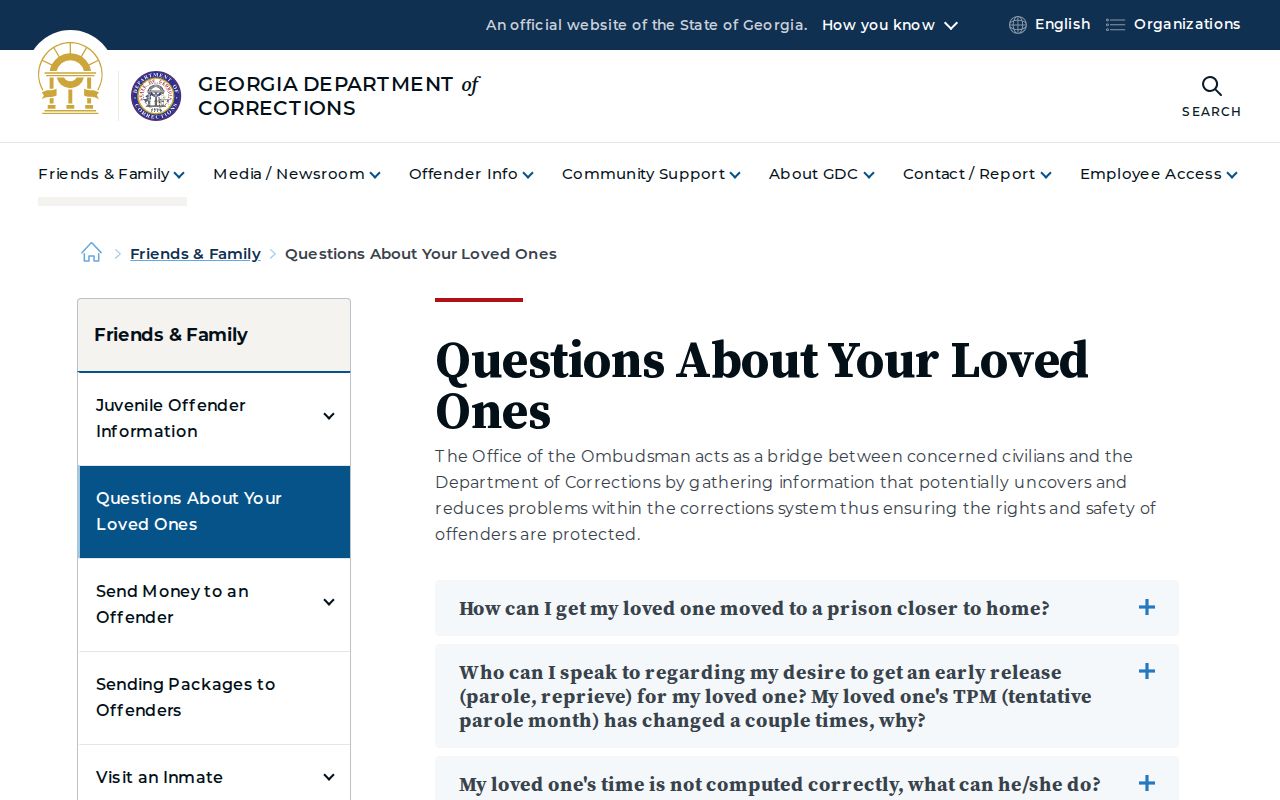
The GDC page supports the state-prison search route, while county-jail dates still require Rabun sheriff and court records.
Rabun County Earned-Time Rules
Georgia has several sentence and parole concepts, but no universal rule that every inmate serves the same percentage. O.C.G.A. § 42-5-101 allows work incentive credits tied to academic or vocational attainment, work performance, and satisfactory conduct. The GDC Performance Incentive Credit program, or PIC, lets eligible state offenders accumulate up to twelve points, potentially reducing TPM or MRD by one to twelve months.
PIC has exclusions. GDC lists death sentences, terms of two years or less, non-parole-eligible offenses, minimum mandatory sentences, and life sentences among the limits. Credits are therefore not automatic and do not apply to every Rabun County case. A court sentence, classification, offense, conduct record, and parole status all matter.
Parole eligibility also differs from release. O.C.G.A. § 42-9-45 generally provides initial consideration after nine months or one-third of a felony term, whichever is greater, unless an exception applies. Many people are not released at the first eligibility point. O.C.G.A. § 17-10-6.1 imposes mandatory rules for serious violent felonies. Georgia should not be described with a blanket eighty-five-percent claim.
The GDC PIC page is shown below.
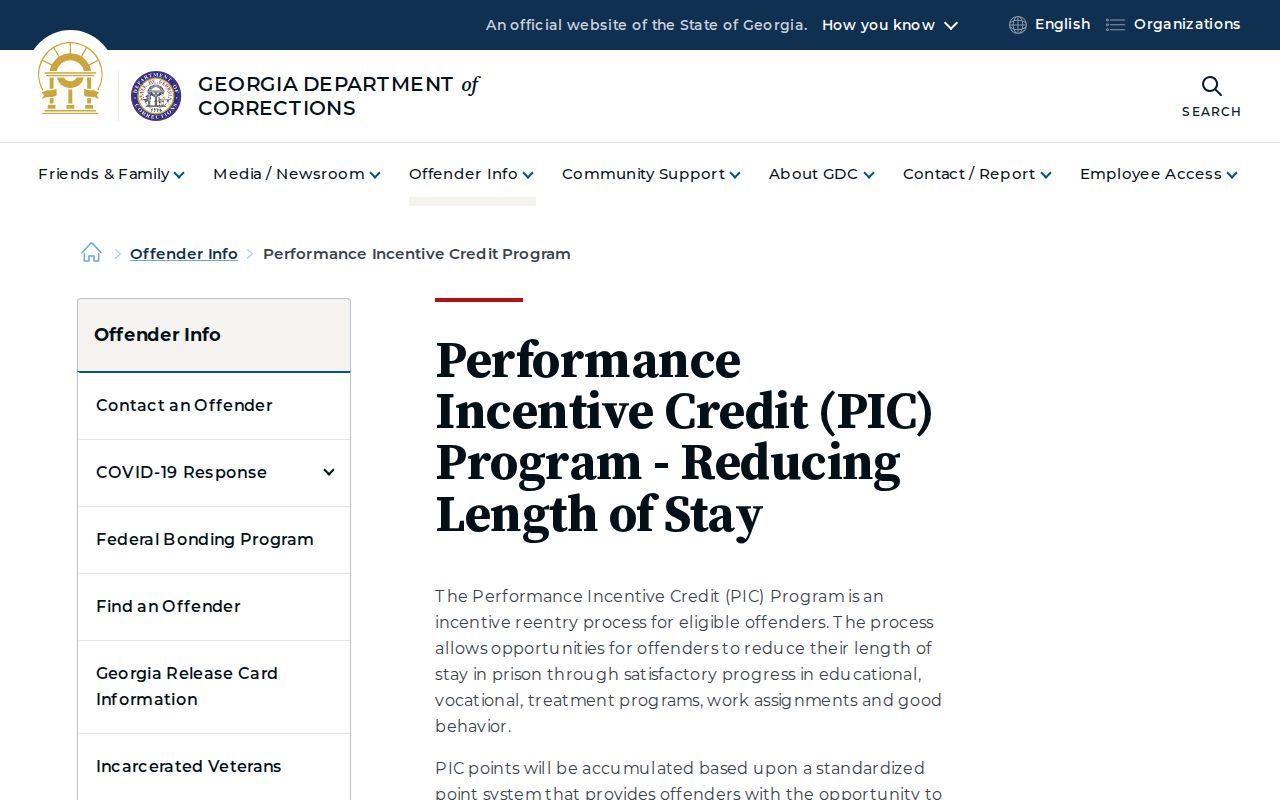
The program details show why an earned-time question needs an individual eligibility check, not a simple subtraction from the sentence.
Why Rabun County Dates Change
A calculated date can move or stop being the next custody event. Each agency controls only its part of the record. The Rabun sheriff may complete local time while another warrant or jurisdictional hold remains. GDC may adjust a state calculation. The parole board may postpone a TPM after misconduct or unmet programming. A court can amend or clarify the judgment.
| Factor | Possible effect | Check with |
|---|---|---|
| Good conduct or eligible credit | May reduce a state TPM or MRD | GDC |
| Disciplinary loss or misconduct | May postpone or cancel parole planning | GDC and parole board |
| Rabun or outside warrant | May keep the person in custody or cause transfer | Sheriff and issuing court |
| Detainer or transport | May lead to another agency's custody | Holding and receiving agencies |
| Court order | May change bond, credit, sentence, or release | Rabun Clerk and court |
| Parole vote | May set, defer, or deny release | Parole board |
Note: “Released from Rabun” can mean transfer to GDC, another county, federal authorities, or immigration custody rather than release into the community.
Rabun Jail Date Computation Caveat
Rabun County's distinctive issue is the lack of a public future jail schedule. The sheriff ties that policy to holds, pending warrants, and transport after local time. State-prison terms such as MRD and TPM should not be applied to a county bond-out or a pretrial stay. A bond can be posted, rejected, changed, or followed by another hold without creating a state corrections date field.
For local cases, use the court judgment to identify the sentence, then ask the jail or clerk about the record that reflects time served and the final legal event. For state cases, use GDC and the parole board. A VINELink Release Check may provide a custody-change alert when the record participates, but it is not a certified date calculation.
After release, request the booking and release record or check the disposition. That completed record can show whether the person bonded out, served time, was transferred, or left under a court order. It is stronger evidence than a projected date captured earlier.
A Rabun County court calendar shows that a hearing is scheduled, not what the judge will decide. Bond, plea, sentencing, revocation, and transport can occur on different days. Georgia Courts e-access may send a search to a provider that requires registration. The Rabun Clerk remains the local source for a judgment, sentence, bond order, disposition, or later docket entry. When the online case view lacks the needed paper, ask the clerk for the record instead of estimating an exit from the calendar.
Identity checks matter as much as date fields. Common names can return several GDC results, and one person may have county and state records from different periods. Compare the GDC number or parole identifier, birth information, offense, and facility when those fields are available. Note when the result was viewed because custody and sentence fields can change. An older screenshot of a TPM proves only what the board system displayed at that time.
Release alerts provide notice rather than a certified calculation. Georgia VINE may send a phone, text, email, or app update for a participating custody record. Data delays and transfers can affect the display. After an alert, confirm the event with the holding agency and ask whether it was release into the community or transfer to another custodian. That distinction is vital in Rabun County because the sheriff warns that outside holds and transportation can follow the end of local time.
A court sentence may also include credit for time already served. The judgment and the custodial agency's computation should be read together. A date reached by subtracting days from the announced term may omit credited time, consecutive terms, mandatory portions, or another active case. GDC computes state time under its rules. The Rabun jail and court records govern local custody facts. Neither calculation should be borrowed for a federal or immigration record.